If you’ve jumped back into Rainbow Six Siege for the 2026 ranked season or are a new player trying to learn the ropes, one of the first questions you’ve probably asked is how many maps are in rainbow six siege. Over the past 11 years since the game launched, Ubisoft has added, reworked, and rotated dozens of maps to keep the meta fresh, and 2026 is no exception with two brand new map drops and a full rework of a fan favorite. I’ve been a Siege coach and semi-pro player since 2021, so I’ve tracked every map change closely to help my students skip the learning curve and focus on winning rounds. This guide breaks down every map currently in the game, plus key details you need to know to perform better in every queue.
How Many Maps Are in Rainbow Six Siege as of 2026?
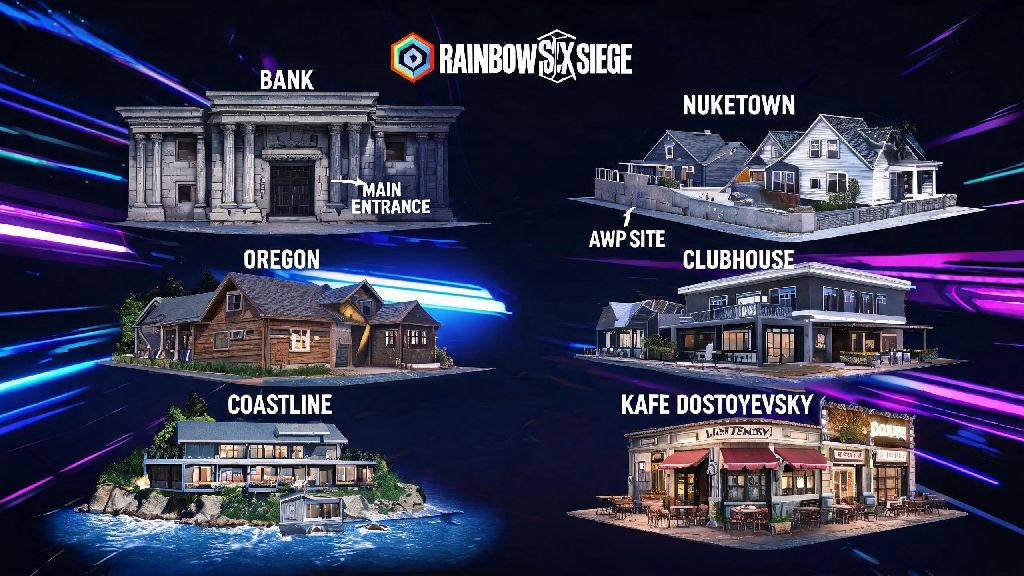
As of mid-2026, there are 24 permanent core maps in Rainbow Six Siege, plus 3 limited-time event maps active for the Year 11 Season 2 summer event. That number shifts slightly every few months as Ubisoft adds new maps, retires underperforming ones, or runs limited seasonal events with exclusive layouts. The core map pool is split across different queues, so you won’t see every map in every game mode, which takes a lot of pressure off new players trying to learn everything at once.
Only 16 of the 24 core maps are in the current ranked map rotation for 2026, which is the same pool used for unranked, tournament, and esports play. The other 8 core maps are limited to casual and custom lobbies, either because they’re still in balance testing before joining ranked, or they have permanent design quirks that make them unfit for competitive play. The event maps rotate out every 4-6 weeks, so they’re not worth memorizing unless you’re grinding limited-time event rewards.
Breakdown of the 2026 Core R6 Siege Map Pool
The 24 core maps are split into three distinct groups based on playstyle and queue availability, so you can prioritize which ones to learn first depending on what you play most. A common mistake new players make is trying to memorize every callout on every map at once, which leads to burnout and messy in-game decisions. Instead, focus on the pool for your main queue first, then expand to other maps as you get more comfortable.
Here’s the breakdown of each group:
If you’re looking for a full breakdown of each ranked map’s best site holds and attack paths, check out our 2026 ranked map strategy library for free callout sheets and operator picks for every site. Even if you only play ranked, knowing how many maps are in Rainbow Six Siege’s current rotation will help you plan your practice schedule efficiently, so you don’t waste time learning maps you’ll never see in competitive play.
Key Map Changes to Note for the 2026 Season
The biggest 2026 map update is the full Clubhouse rework 2026 that dropped in Year 11 Season 1. Ubisoft adjusted the bar site stairwell to eliminate the common unfair defender spawn peek, added a new exterior hatch on the garage roof to give attackers more vertical play options, and removed a few hidden defender angles that had been abused for years. The reworked Clubhouse is now one of the most balanced maps in the ranked pool, with roughly 50/50 win rates for attack and defense across all skill brackets.
Two brand new maps also joined the core pool in 2026: Coastal Docks, a medium-sized shipping port map set in Portugal, and Mountain Outpost, a larger alpine military base map set in the Swiss Alps. Coastal Docks joined the ranked pool immediately after launch, thanks to extensive beta testing that fixed most balance issues before its full release. Mountain Outpost is currently in the casual only pool while Ubisoft tweaks a few overly powerful defender sightlines on the upper floor, and it’s expected to join ranked in late 2026.
Ubisoft also retired the original Bank map from the core pool earlier this year, after 8 years of it being in rotation. The map had too many unbalanced sightlines and layout issues that couldn’t be fixed without a full rework, and Ubisoft has confirmed a reworked Bank map will launch in Year 11 Season 4. The 2026 map changes fix most of the complaints players have had about unfair advantages, no matter how many maps are in Rainbow Six Siege at any given time.
Tips to Learn R6 Siege Maps Fast in 2026
You don’t have to spend 100 hours memorizing every nook and cranny of a map to play it well. The fastest way to learn new maps is to focus on high-impact details first, rather than trying to remember every single minor callout. Start with the 4 main site locations on each map, then learn the main rotation paths between sites, common soft wall destruction spots, and hatch locations. That’s enough to hold your own in most ranked matches, and you can pick up smaller details as you play more rounds.
Custom game practice is the most underrated tool for learning new maps fast. Load up a private custom game with no enemies, and spend 10 minutes walking through each floor, testing which walls are soft, where the camera locations are, and which angles defenders usually anchor from. You can also test spawn peek locations to learn which ones you need to watch out for when attacking, and which ones you can use as a defender. This low-pressure practice cuts your learning time in half compared to trying to learn maps during live matches.
Don’t leave matches just because you get a map you don’t know. It’s tempting to dodge when you load into Coastal Docks for the first time and have no idea where to go, but every round you play on an unfamiliar map teaches you small details you won’t get from custom games or guides. Even if you lose the match, you’ll pick up new callouts and trick spots that will help you win future rounds on that map. Most players get comfortable with a new map after 5-10 full matches, so don’t get discouraged if your first few rounds are messy.
Whether you’re grinding for Champion rank or just playing casual matches with friends, knowing how many maps are in rainbow six siege and which ones to prioritize will save you dozens of hours of unnecessary practice. The 2026 map pool is the most balanced it’s ever been, with plenty of variety for every playstyle, from fast-paced close quarters maps to slower, more strategic large maps. Take it one map at a time, focus on the pool for your main queue, and don’t be afraid to experiment with different operator picks to find what works best for you on each layout.