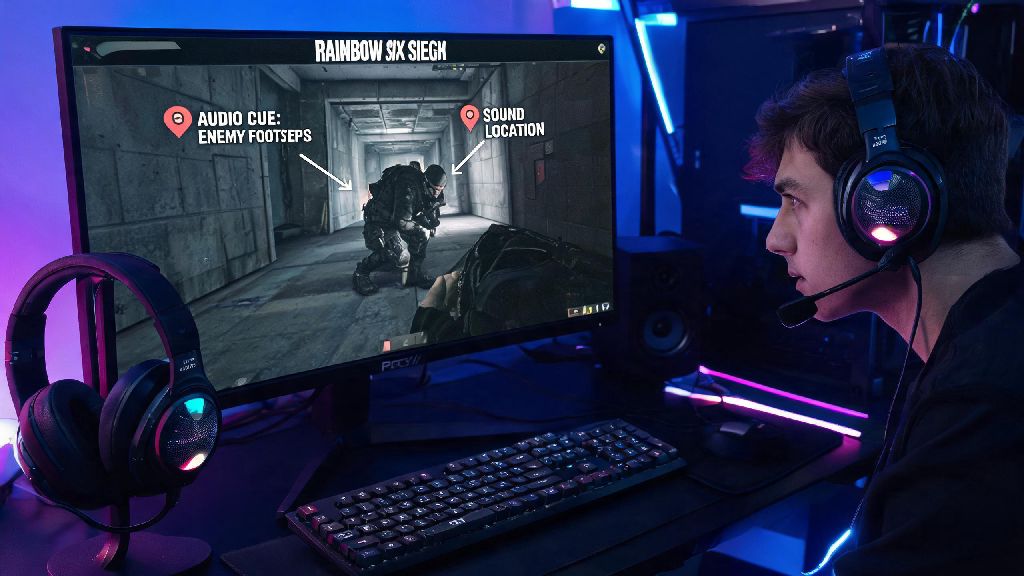
We’ve all been there: you’re holding a 1v1 on the final site, you swear you hear a footstep to your left, so you pre-aim the door only to get peeked from right behind you by an enemy who snuck through soft floor. If that frustrating loss sounds familiar, you’ve probably asked what is the best headset for Rainbow Six Siege at least once. Unlike most other FPS games, Siege’s entire competitive loop revolves around tiny, easy-to-miss audio cues: the faint whir of a hidden drone, the high-pitched beep of a breaching charge, even the soft hum of a Mute jammer hidden behind a wall. A bad headset doesn’t just make the game less immersive, it actively costs you rounds, rank, and the fun of pulling off a perfect hold.
Key Features to Look for When Answering What is the Best Headset for Rainbow Six Siege
Before you start browsing listings, it’s important to know exactly what features matter for Siege specifically, not just general gaming. You don’t need fancy RGB lights or Bluetooth connectivity to rank up, but a few non-negotiable features will make a world of difference in your play. 3D spatial audio support is the most important, as Siege’s custom audio engine is built to deliver precise positional cues, so you can tell if an enemy is one floor above you, on the other side of a soft wall, or creeping down the hallway 10 feet away. Frequency response tuned for mid-range sounds is next, since nearly all critical Siege audio cues (footsteps, drone beeps, gadget activation sounds) fall in the 1kHz to 8kHz range, so headsets that boost this range will make those cues pop without blowing out your eardrums when a shotgun goes off right next to you.
You’ll also want a Closed-back design to block out background noise from your home, whether that’s a roommate watching TV in the next room or a fan running in the summer. Lightweight, long-wear comfort is often overlooked, but if you’re pulling 4-hour ranked sessions to climb to Diamond, sore ear cups or a tight headband will distract you faster than a toxic teammate spamming text chat. Too many people waste money on headsets that look cool but don’t deliver on the features that actually matter for Siege, and there are a few common mistakes you’ll want to avoid entirely:
It’s easy to get pulled in by flashy marketing, but if a headset doesn’t check those four core feature boxes, it’s not worth your money, no matter how cool it looks on your desk. If you're still asking what is the best headset for Rainbow Six Siege and don't have much to spend, start with a budget option that checks all the core feature boxes.
Budget Pick Headsets for Casual and New Siege Players
You don’t need to drop $200+ on a high-end headset to have fun and win rounds in casual or unranked play. Budget headsets in the $50 to $80 range have come a long way in the last few years, and many now include spatial audio support, closed-back designs, and perfectly functional mics for team chat. You don't need to spend top dollar to get a competitive edge in casual or unranked play, and many budget options perform just as well as mid-range models for players who only log a few hours a week.
That said, there are tradeoffs to budget options. Most use plastic frames instead of aluminum, so they’re more likely to break if you drop them or toss them in a backpack for a LAN party. The ear padding is also usually thinner, so if you play longer than 3 hours at a time, you might start to feel pressure on the sides of your head. I tested a $65 budget model last year when my main headset broke right before a ranked session, and I still climbed from Gold 2 to Platinum 3 using it over the course of two months, so you absolutely don’t need to overspend if you’re just getting started or play casually.
Mid-Range Headsets for Ranked and Semi-Competitive Play
If you’re logging 10+ hours of Siege a week and pushing for Platinum or Diamond rank, it’s worth upgrading to a mid-range headset in the $100 to $180 price bracket. These headsets almost always have better spatial audio tuning specifically optimized for FPS games, thicker memory foam ear cups that stay comfortable for 6+ hour sessions, and noise-cancelling mics that filter out background noise so your team can hear your callouts clearly even if you have a fan running. Most pro Siege players use mid-range headsets, not the most expensive flagship models, because they deliver all the performance you need without extra features that add unnecessary cost or latency.
For players who take ranked seriously, the answer to what is the best headset for Rainbow Six Siege will almost always fall in the mid-range price bracket. Many mid-range headsets also have swappable ear pads and detachable mics, so you can replace worn parts instead of buying an entirely new headset when something breaks. The only real downside to mid-range headsets is that most don’t have customizable EQ profiles out of the box, so if you want to tweak the sound to pick up very faint footsteps, you’ll need to use third-party software on your PC or console.
Premium Headsets for Pro Players and Content Creators
Premium headsets in the $200+ range are only worth it for a small subset of Siege players: people who compete in local or online tournaments, stream Siege full time, or log 20+ hours of play a week. These headsets offer studio-level sound accuracy, fully customizable EQ settings, and ultra-low latency connections that eliminate any delay between when a sound plays in game and when you hear it. Premium headsets offer studio-level sound accuracy and customizable EQ settings so you can tune audio exactly to your play style, whether you want to boost mid-range footsteps for ranked play or balance audio for streaming commentary.
Most premium headsets also have broadcast-quality mics that make your voice sound crisp and clear for both team chat and streams, and they’re built with durable aluminum frames that can last 3 to 5 years even with heavy daily use. That said, if you only play a few hours a week or don’t care about streaming audio quality, you won’t notice enough of a difference between a premium headset and a mid-range model to justify the extra cost. I got a $300 premium headset as a gift last Christmas, and I still go back to my $120 mid-range model for most ranked sessions, since it fits my head better and sounds just as good for the cues I care about.
At the end of the day, the answer to what is the best headset for Rainbow Six Siege depends entirely on your play style, budget, and how much time you put into the game. The most important thing is to prioritize sound accuracy and comfort over flashy features, because those are the two factors that will directly impact how well you play. If you can, try on a headset in person before you buy it if possible, to make sure it fits your head comfortably, because even the best sounding headset will be useless if it gives you a headache after an hour of play. No matter what you pick, upgrading to a headset built for Siege’s unique audio cues will help you win more rounds, climb higher ranks, and have more fun every time you queue up.